
By Marty Mulrooney
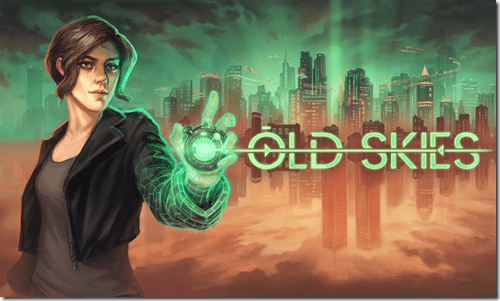
Old Skies is a point-and-click adventure game designed by Dave Gilbert and published by his independent studio Wadjet Eye Games. Having collaborated with other indie developers in recent years, this is his first personal project since Unavowed in 2018. Featuring 1080p hand-drawn graphics by artist Ben Chandler, an original score by composer Thomas Regin and professional voice acting from a large cast, Old Skies recently launched on PC, Mac and Linux after almost six years in development and will soon arrive on Nintendo Switch.
Time travel stories can be wonderful when they’re done right, whether it’s in popular films such as Back to the Future or classic video games such as Day of the Tentacle. However, pulling them off can be tricky, which is probably why the truly good ones – the time travel stories that will stand the test of time (pun intended) – are few and far between.
Old Skies tackles its subject matter in a manner that is both fresh and unique. Set in the year 2062 (sometimes), players take control of time agent Fia Quinn as she undertakes missions for the ChronoZen agency in New York City. Her job is to take those who can afford it into the past to sightsee or resolve unfinished business, making sure nothing goes wrong in the process.
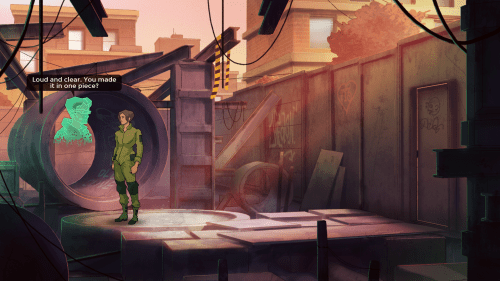
Of course, things inevitably (and invariably) do go wrong in Old Skies, with much of the gameplay involving Fia scrambling to fix the timeline and save the day. There are many rules and regulations to consider when time travelling, and the game does an excellent job of disseminating this information throughout its lengthy runtime. You won’t always understand the terminology used right away, but all will be revealed…
Each chapter introduces a new client, mission, time period and supporting characters. It keeps things feeling fresh despite the game’s impressive size, and jumping between different points across 200 years of New York City’s history is fascinating. Yet it’s the people, rather than the places, that prove consistently compelling. Seemingly minor decisions can have major repercussions, and Fia must always balance her clients’ wishes against the lives of others, many of whom are long since dead.
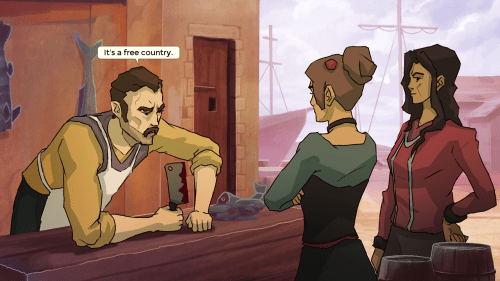
In an early mission, Fia travels back to the Gilded Age at the end of the 19th century so her client can ask someone for retirement advice – it sounds easy enough. However, she soon becomes embroiled in the activities of a vicious gang as she desperately tries to save the life of a troubled boxer. It’s a sign of things to come, with each ‘fix’ to the timeline having a knock-on effect that must then be addressed. This mission also introduces a major gameplay mechanic, whereby time will immediately rewind if Fia dies.
It’s an interesting feature, as it’s only through Fia dying multiple times – with these deaths often proving shockingly brutal – that the player can figure out the correct sequence of events to survive. However, it sometimes requires the same dialogue sequences to be replayed over and over again, which can become a bit grating; although it should be noted that the entire end sequence of the game leans heavily into this mechanic and is executed beautifully, delivering some of the best puzzle-solving gameplay Dave Gilbert has designed to date.
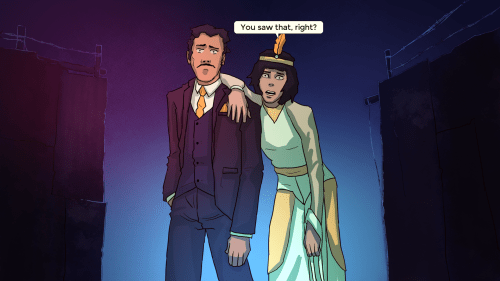
The timeline is constantly changing as a result of each mission, but whether Fia is visiting a speakeasy during Prohibition or a futuristic tech company, she can always rely on her handler Frank Nozzarelli, aka ‘Nozzo’. The player can call Nozzo at any time by clicking the phone icon at the top of the screen, which will cause his hologram to pop up next to Fia. They can then chat without anyone else hearing via ‘subvocalisation’. He can give hints if the player is stuck (without outright spelling out what you need to do next), but he is also a great source of companionship in a job that is extremely isolating.
There is also a historical archive that is constantly being updated, and the player is often tasked with matching first names with last names to reveal new information that can then be used to further the plot. The puzzles are mostly of the conversation-tree variety, with new locations opening up as the player makes fresh revelations. There is a traditional inventory, but Fia has a multitool that can deal with most locks, and the days of trying to use every item with every hotspot – and failing that, endlessly trying to combine them with each other – have been left in the past.
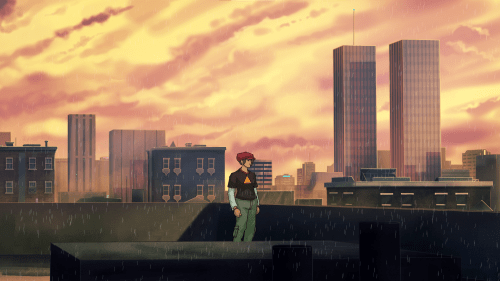
One of the most memorable missions takes place the day before September 11, with Fia trying to solve a murder before the Twin Towers fall and the crime gets lost in the confusion that follows. The rules of time travel, where every person has a timeline impact rating of low, medium or high, mean Fia can only alter the future of individuals who are considered to have a minimal impact on the overall course of history, as decided by the top brass at ChronoZen. It’s an understandable yet deeply frustrating rule, and how this part of the game is handled is both sensitive and reflective.
The emotions this mission brings to the surface also highlight a deeper sadness at the heart of Fia’s existence. ChronoZen agents are specifically chosen because they have no ties and can accept the constantly shifting reality of their ‘now’ when they return to the present. There are other ChronoZen agents around the world also undertaking missions in the past, and this means that the present is fluid, with people, places and things popping in and out of existence. This makes the life of a time agent a lonely one, as they can never commit to anything other than the job and their colleagues. Everything else is only temporary.

Fia is a character who undergoes massive change throughout the course of the game’s events, and like most people, she struggles to separate the thoughts in her head from the feelings in her heart. I don’t want to spoil where the plot eventually ends up, but Dave Gilbert cleverly uses the smaller stories told in each mission to build an underlying, universal theme. The end of the game is fuelled by the emotional build-up of everything that has come before, and it’s a payoff that proves bittersweet in the best way possible.
Bolstering the quality of the storytelling are the game’s high production values. Led by Sally Beaumont as Fia and Edwyn Tiong as Nozzo, the talented voice actors give authentic and believable performances across the board, ensuring that the pacing never drags despite the heavy focus on dialogue and conversation. The hand-drawn graphics are beautiful too, particularly the backgrounds and the close-up shots, with each time period vividly realised, and Thomas Regin’s score hits all the right notes.
Old Skies is a streamlined point-and-click adventure that successfully mixes the old with the new. Hovering over certain hotspots will give a text-only description, which I found disappointing at first but soon came to appreciate. Likewise, the reduced focus on inventory-based solutions allows the surprisingly deep story to flow with few interruptions. Purists may baulk at some of these modern concessions, but like another recent adventure that I enjoyed a great deal, I found the overall experience compelling. This is one of Dave Gilbert’s best adventures to date, which should be taken as high praise indeed if you’ve ever played any of the Blackwell games. Fans of the genre owe it to themselves to check it out – I have a strong feeling it’s going to stand the test of time. TIMELINE IMPACT RATING: High.
9 OUT OF 10


 Martin Mulrooney
 Guest/Previous


 Alternative Magazine Online