
By Marty Mulrooney
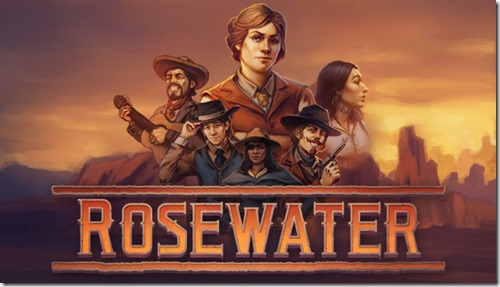
Rosewater is a Wild West point-and-click adventure game set in the alternate 19th-century world of Vespuccia. Developed by Grundislav Games (Francisco González) and published by Application Systems Heidelberg, players take control of brawler-turned-writer Harley Leger as she travels across the frontier with five eclectic companions in search of a missing fortune.
Featuring beautiful hand-drawn, high-resolution graphics (in 720p!), fully rotoscoped animations and cinematic closeups, Rosewater deftly straddles the line between retro and modern. From the opening credits on board a stream train, transporting Harley and the player to the titular town where it all began, it’s clear this will be an adventure with scope – and I’m not just talking about the rolling desert plains. It’s certainly a technological step up from the developer’s previous games, Shardlight and Lamplight City, which were decidedly more old school in their pixel-art approach.
That’s not to say that Rosewater is cutting edge, but it certainly feels like a modern take on the classics. Set in the same steampunk-ish, alternate reality United States as Lamplight City, the year is 1850, and the game begins with Harley Leger arriving in the town of Rosewater in pursuit of a job at the local newspaper. Yet she has hardly stepped off the train before a pair of local grifters try to pickpocket her. Grabbing the younger man’s arm, the player is given their first of many choices in an adventure spanning dozens of hours. These choices will only get harder.
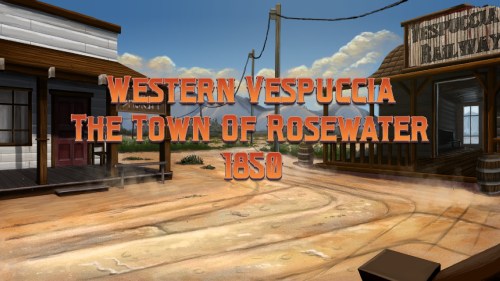
Harley is a talented writer, and securing gainful employment proves easy enough (after introducing herself to the town sheriff and doctor, and deciding whether to help a man violently thrown from a second-floor window). Her first assignment is to write a puff piece about ‘Gentleman’ Jake Ackerman, a legendary frontier showman performing at the local theatre. However, as is common in the genre, gaining access to the theatre first requires some traditional inventory and conversation-based puzzle solving.
The show proves entertaining enough once Harley enters the theatre, but the real intrigue comes later on. After helping Jake and his assistant, the sharpshooter Danny Luo, in a barroom brawl, Harley gets the interview she needed to write her story, along with a highly intriguing proposition. Jake has heard through the grapevine that a disgraced scientist who caused a public disaster in Lamplight City has since gone missing, leaving behind a lost fortune. Picking up the scent of a better story, Harley agrees to join them in their search for fortune and glory.
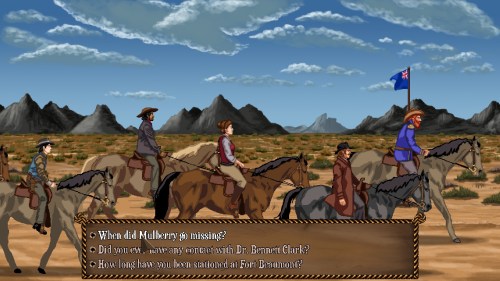
It’s a compelling tale told at a leisurely pace, and one of the game’s best features is Harley’s detailed journal, which is filled in as the adventure progresses. It’s a proper journey too, a bona fide road trip that starts at the abandoned desert lab of Dr Bennet Clark and ends at the sprawling lamp-lit city of El Presidio. And yet – and hopefully this doesn’t sound too cliche, because it’s true – it’s everything that takes place between these two pivotal locations that really matters. That’s right: Rosewater is more about the journey than the destination.
Harley, Jake and Danny eventually hire a pragmatic and stoic woman called Lola to transport them in her wagon from Rosewater to El Presidio, and several other characters join them as various subplots come to the fore. This is no ragtag group either, despite the usual conventions of the genre. Each member is more than capable in their own way, and sharing such close quarters on the wagon for the majority of the journey – and indeed, the game – means that Harley will get to know each of them intimately by the time they reach their final destination.
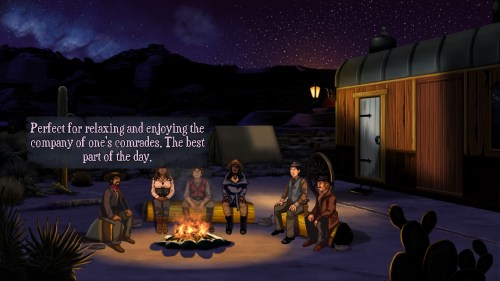
But I’m getting ahead of myself. Again, it’s the journey where the real adventure lies, with the wagon making various pit stops that I later realised were somewhat random in nature. From joining an archaeological dig to helping an old sea captain let go of the past (my favourite tangent of the game), you’re always kept on your toes and never quite sure what to expect – and the experience won’t be exactly the same for each player.
Sometimes these excursions are self-contained mini-adventures (with the occasional mini-game), while other times they tie in to the central plot regarding Dr Clark and his missing fortune. The puzzles are well designed but fairly straightforward for the most part, with the difficulty ramping up near the end. This isn’t necessarily a game about challenge; rather, it’s about facing moral quandaries, making decisions that you can live with and deciding what kind of person you want Harley to be.

With most of the game spent conversing with other characters, perhaps even more so than is usual for the genre, it’s a relief that the voice actors are so brilliant across the board. Maya Murphy does most of the heavy lifting as Harley, and her conversations with Gavin Hammon as ‘Gentleman’ Jake are a particular highlight. Christian Lanz is likewise excellent as Mexican revolutionary Filomeno ‘Phil’ Marquez, who often keeps the gang entertained around the campfire with his guitar playing and Spanish singing.
There isn’t enough room to mention everyone, but the ‘Meet the Cast’ image above – shared by developer Francisco González – gives a pretty good idea of just how talented this ensemble of top-tier union voice actors is. I was particularly delighted to note Roger Clark’s involvement following his star-making turn as Arthur Morgan in Red Dead Redemption II – he brings several of the supporting characters to life, and none of them are quite what you’d expect from one of the most memorable gunslingers in modern entertainment.
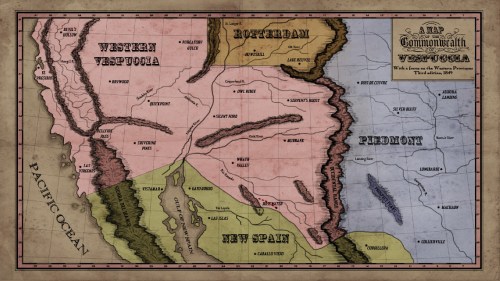
The soundtrack composed by Mark Benis (who also composed the soundtrack for Lamplight City) is similarly accomplished, with real players and instruments authentically replicating the sounds of classic spaghetti Western films while also bringing something unique and otherworldly to the mix. Soaring violins, triumphant horns and delicately strummed guitars are joined by more unusual instruments such as the jaw harp and didgeridoo, creating a pleasant soundscape that always matches the on-screen action.
My biggest complaint is that some players won’t achieve the ‘best’ ending; it will all depend on their actions and the relationships they build throughout the game. I was overjoyed to witness a particular character arc reach its powerful, redemptive conclusion, and it pains me to think that not everyone will see it. It was such a satisfying ending that I can’t imagine anything less living up to it. Replayability in itself is a positive, of course. However, this is a very long game, and I imagine most players would rather commit to their own personal journey, for better or worse.
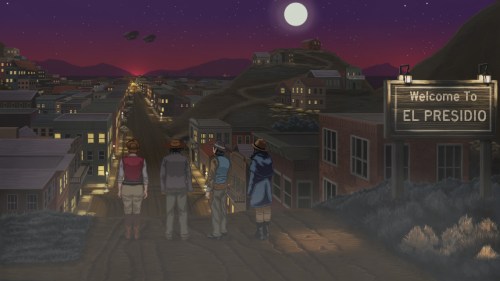
Rosewater is a point-and-click adventure that has clearly had a lot of passion poured into it, and the end result is a journey well worth taking. It meanders, and there are moments of frustration, but the overall experience is stellar. Harley Leger is a fully realised, well-written protagonist, and her makeshift gang of fellow travellers and fortune-seekers more than makes amends for any slumps in momentum concerning the main plot. You’ll start out wanting to find the hidden fortune, but I’d bet my bottom dollar that you’ll simply be sad to say goodbye to your new friends once it’s all over. Now that’s good writing.
9 OUT OF 10


 Martin Mulrooney
 Guest/Previous


 Alternative Magazine Online