
By Marty Mulrooney
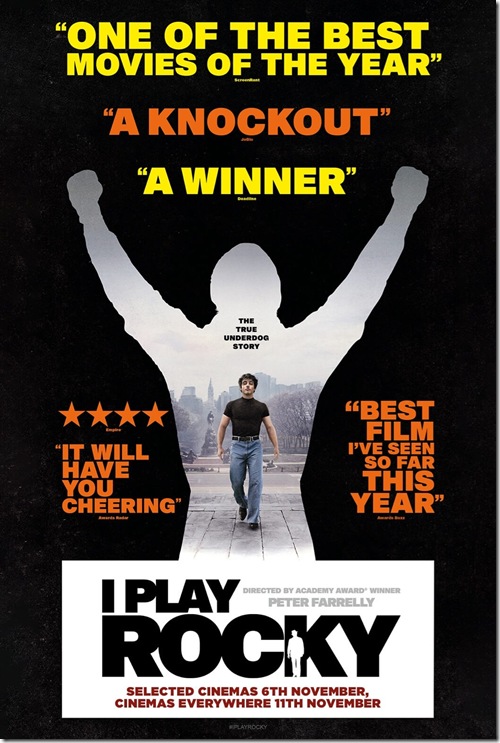
I Play Rocky is a biographical drama film that tells the true-life story of a young Sylvester Stallone and his fight to become a serious actor in the 1970s. Directed by Peter Farrelly and starring Anthony Ippolito as Stallone in a career-defining performance, it follows the development and production of the Academy Award-winning boxing film Rocky – proving truth really is stranger than fiction.
Regardless of your stance on Sylvester Stallone and his films, it’s hard to deny his talent, determination and self-belief. It’s easy to see these qualities in him now, after a lifetime of ups and downs in Hollywood, but it wasn’t always obvious – even to Stallone himself. When I Play Rocky begins, Stallone (Ippolito) is struggling to make it as an actor in New York City. Calling himself Mike rather than Sylvester, he takes bit parts when he can, juggling a string of unsuccessful auditions with low-paying jobs that leave him on the edge of homelessness.
He is eventually forced to star in a softcore pornographic film just to pay the rent, and his charismatic but abusive father does little to keep his dream of acting stardom alive. It’s only when he meets aspiring photographer Sasha Czack (AnnaSophia Robb) while they’re both working as movie theatre ushers that his outlook on life starts to change. Sasha encourages him to start using his real name and plants an important idea in his mind: if he can’t get any good film roles, why not write one for himself?
The film has plenty of unbelievable-if-it-wasn’t-true anecdotes to work with, but I Play Rocky would have fallen at the first hurdle if not for Anthony Ippolito. Best known for his portrayal of Al Pacino in the Paramount+ miniseries The Offer (2022), Ippolito becomes Stallone in a way that feels alchemical. It’s a performance that goes beyond mere impression; when Stallone is shown recording his voice into a battered reel-to-reel tape recorder, trying to overcome his speech impediment (caused by nerve damage sustained during birth), the actor disappears – all you can see is a real person struggling to achieve the impossible.
The film is at its most exciting when Stallone is negotiating with film producers Robert Chartoff (Toby Kebbell) and Irwin Winkler (P. J. Byrne) in LA – and, by proxy, the head of United Artists. They all want Rocky, but they don’t want Stallone. And even when Chartoff and Winkler are finally convinced to take a chance on casting an unknown in the lead role, United Artists won’t budge. Life-changing amounts of money are put on the table; each time, Stallone turns them down. He has to sell his dog due to his dire financial situation, and Sasha is now pregnant, but he can’t be bought. He knows this is his one chance to realise his dream.
It’s an underdog story that proves just as inspiring as Rocky Balboa’s, and it remains engaging throughout – despite the audience knowing how it will all turn out. Directed in a no-nonsense, workmanlike manner by Farrelly, who previously cut his true-life drama chops with Green Book (2018) after starting his career in the ’90s with the gross-out comedy Dumb and Dumber, it leans heavily on the viewer’s familiarity with and affection for Rocky, especially in the second half.
Paradoxically, the looming shadow of Rocky is the only thing holding I Play Rocky back. It’s hard – if not impossible – for a film to forge its own identity when it shares so much of its DNA with a cinematic masterpiece; you likely won’t remember much of the original score, because how the hell can anyone compete with Bill Conti and ‘Gonna Fly Now’? Meanwhile, the recreations of classic Rocky scenes are almost spooky in their faithfulness to the original film, yet the only other actor with real screen time during the production scenes is Carl Weathers, played with appropriate levels of charisma and overconfidence by Stephan James.
We see incredibly accurate likenesses of Talia Shire, Burt Young and Burgess Meredith, but there are few scenes where we see them interacting with Stallone. How did these much more seasoned actors feel about working with a lead whose résumé included Subway Thug #1? I Play Rocky, already over two hours long, doesn’t have enough time to tell these stories. Yet it is so enjoyable, and taps into so much of the energy that made Rocky a hit, that it could surely have been forgiven for running a little longer to more satisfactorily balance the film’s contrasting halves.
Ultimately, I Play Rocky succeeds on the strength of Anthony Ippolito’s incredible, transformative central performance. A story that could have easily become overly saccharine instead develops into a riveting character study that still has time for crowd-pleasing moments. There’s a little bit of movie magic happening here, and it isn’t just down to nostalgia or rote recreation. By tapping into the humanity of Stallone pre-stardom, and not just the knockout effect of Rocky, it manages to go the distance.
8 OUT OF 10


 Martin Mulrooney
 Guest/Previous


