
By Marty Mulrooney
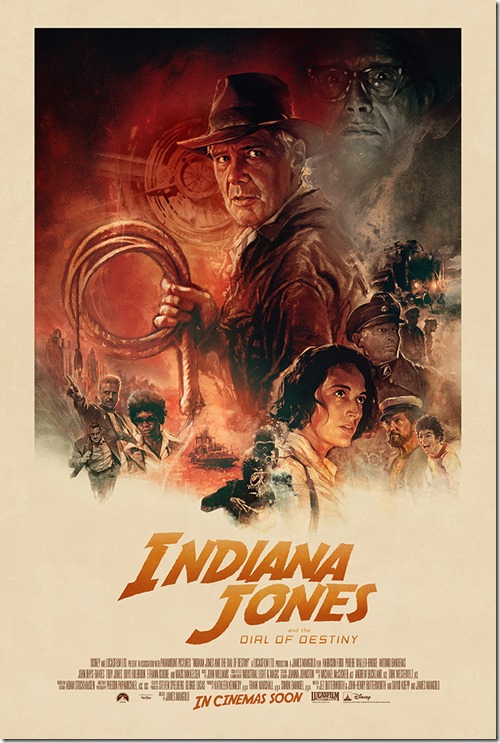
Indiana Jones and the Dial of Destiny is the fifth and final major motion picture (for Harrison Ford, at least) in the iconic film series that started with Raiders of the Lost Ark in 1981. Arriving 15 years after Indiana Jones and the Kingdom of the Crystal Skull, directing duties have this time been handed over to James Mangold (Logan, Ford v Ferrari), with the story focusing on a device called the Antikythera – Archimedes’ Dial – that could change the course of history.
The familiar title font, the rousing musical score, the countless little details in the background as hundreds of Nazis prepare to flee a German castle during the Allied liberation of Europe – the opening moments of Indiana Jones and the Dial of Destiny are spectacular. The year is 1944, and World War II is effectively over.
Indiana Jones is introduced with a sack over his head, a prisoner being dragged along by his Nazi captors as bombs explode too close for comfort. Of course, Harrison Ford is 80 years old in real life, so the eventual reveal of Indy’s face at the start of this lengthy prologue involves state-of-the-art de-aging technology from ILM. The initial results, at least, are a minor miracle – this is far beyond any other use of similar technology to date.
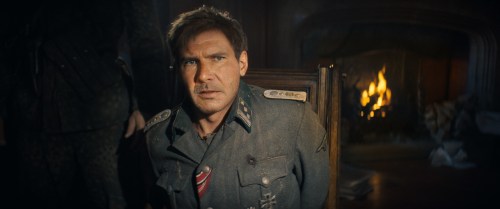
However, it isn’t perfect. It’s convincing when Indy is sitting down or standing still, but as he escapes and starts punching Nazis (hurrah!), there are a fair few moments that cross into the uncanny valley. Yet the overall prologue is such a brilliant set-up – culminating in Indy boarding a Nazi plunder train! – that it’s worth putting up with the technology’s limitations. Like many aspects of Dial of Destiny, the viewers who just go with it will enjoy it the most.
English actor Toby Jones has a small but important part as the bookish Basil ‘Baz’ Shaw, an old ally of Indy’s who tries to rescue him and ends up needing rescuing himself. He does a lot with a little. Meanwhile, Mads Mikkelsen (also de-aged in the prologue) is introduced as Jürgen Voller, a Nazi agent and astrophysicist who has found half of Archimedes’ Dial – finding the other half will purportedly make the owner a god. Indy and Baz aren’t on board the train to acquire the Dial, but they take Voller’s half with them anyway as they make their escape. This will become important later on.
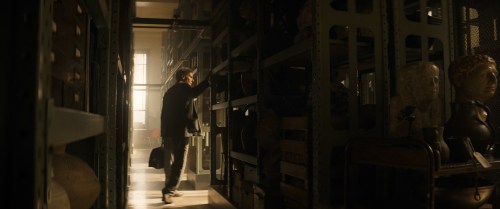
If the opening 20 minutes are a nostalgic return to the fast-paced action and adventure of Indy in his heyday, the sudden jump to 1969 and the movie’s ‘present day’ is a rude awakening. When we last saw Indiana Jones, he was smiling as he walked down the aisle. Now he’s living alone in New York City, about to retire from a stale teaching gig at Hunter College in a world where everyone is looking to the future and nobody gives a damn about the past.
This is Indy at his lowest ebb, and it’s incredibly disorientating to see him as an old man armed with a baseball bat, complaining to his teenage neighbours about the noise they’re making in celebration of ‘Moon Day’. Old age catches up with all of us – if we’re lucky – and James Mangold has done a wonderful job of making Indy’s age a running theme throughout Dial of Destiny without reducing him to a punchline. Dr. Jones is still a capable man, but something is holding him back and dragging him down.
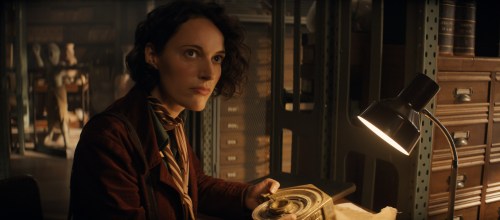
If the above all sounds too depressing and sombre, worry not – this is a film that moves quickly. Following an unexpected visit from his duplicitous goddaughter, Helena ‘Wombat’ Shaw, Indy finds himself being hunted by an older Voller, who is now working for NASA. Indy, Helena, Voller and the CIA (!) all want the Dial, and from this point onwards Dial of Destiny becomes a classic chase movie. The action is well-directed and easy to follow (a somewhat rare blessing in 2023), if not missing some of Spielberg’s dynamism, and the quieter moments in between are beautifully framed.
Admittedly, the use of CGI feels a touch heavy at times, but the enthusiastic performances always manage to ground the action. Phoebe Waller-Bridge as Helena more than earns her co-star credit and is a fitting match for Ford; their natural banter keeps the tone and the spirit light even when the plot becomes heavy. She also has great chemistry with her teenage sidekick Teddy Kumar (Ethann Isidore), who perhaps inevitably evokes fond memories of – and unfair comparisons with – Ke Huy Quan as Short Round in Temple of Doom at first, but later comes into his own.

Helena works well alongside Dr. Jones because she isn’t simply his female equivalent; Indy has a lifetime of past adventures and experience to draw upon when deciding what is right and wrong, while Helena is far less scrupulous. This is still an Indiana Jones film, and it never feels like he is passing the torch. Rather, Helena does her own thing throughout and the result is always interesting to watch. The supporting characters are a lot of fun to watch too, especially John Rhys-Davies as Sallah, gleefully reprising his role from Raiders of the Lost Ark (1981) and The Last Crusade (1989), and an understated Antonio Banderas as Renaldo, an expert frogman and previously unseen old friend of Jones.
Boyd Holbrook (Logan, The Predator) and Dutch bodybuilder Olivier Richters are suitably intimidating as Voller’s henchmen, and Shaunette Renée Wilson as the US government agent trying to keep them all under control is grounded and believable, but their screen time – and lines of dialogue – are limited. It’s hard to decide whether this is a valid criticism, as it’s not necessarily a bad thing to have memorable actors in minor roles. Mads Mikkelsen plays Voller with menacing restraint, making dialogue such as ‘See you in the past, Dr Jones’ sing; his ‘former’ Nazi is more intellectual than theatrical, but it works. Nobody is phoning it in, but there’s only so much character development that can be accomplished in two and a half hours and the focus is quite rightly on Indiana Jones (and to a lesser extent, Helena).
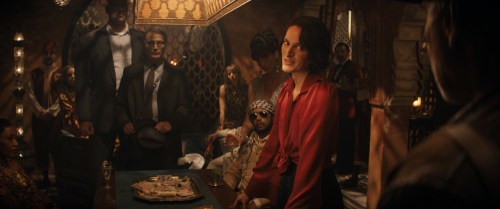
Adding even further character is the orchestral score by longtime series composer John Williams. The iconic ‘Raider’s March’ returns as expected, but it’s the new theme – ‘Helena’s Theme’ – that serves as a throughline throughout the entire soundtrack. It’s a beautiful piece of music, with soaring strings and soft brass notes evoking a bygone era of music and the golden age of cinema. It would have been easy to rehash past Indiana Jones soundtracks – and there are certainly subtle hints here and there – but the soundtrack for Dial of Destiny is as memorable as it is unique.
It would be impossible to discuss the central plot of Dial of Destiny without ruining it, so I won’t. What I will say is that the final act is both epic in scope and audacious. It will undoubtedly split viewer opinion right down the middle, but it’s firmly in line with the final acts of the previous films and the emotional journey of a downtrodden Indiana Jones in his twilight years. This a pulpy and exciting adventure that keeps fan service to a minimum in favour of reaching for something more. It was the right direction to take for this final adventure; James Mangold chose wisely.
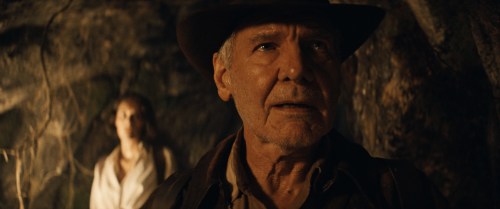
Indiana Jones and the Dial of Destiny is by no means perfect. There are moments where the CGI doesn’t quite land, the story sometimes takes a backseat to the action (sometimes in a tuk-tuk, racing through the streets of Tangier) and it often skirts dangerously close to the edge of plot holes. Yet it’s easy to forgive the occasional bump in the road because Harrison Ford is clearly giving the character his all. In recent years he has reprised two of his most iconic roles as Han Solo in Star Wars: The Force Awakens (and The Rise of Skywalker) and Rick Deckard in Blade Runner 2049.
They were undoubtedly excellent performances, but there’s something truly special about Harrison Ford’s final performance as the man in the hat (and watching him come back). After all, there are few roles that are more iconic than Indiana Jones. The emotion that Ford displays in Dial of Destiny feels real, elevating everything and everyone around him. Whether he’s experiencing pain or joy you’ll feel it with him, and perhaps the greatest surprise of this last hurrah is that it is genuinely moving on a raw, emotional level. Over 40 years ago, Indiana Jones told Marion Ravenwood ‘It’s not the years, honey. It’s the mileage.’ Dial of Destiny proves that he was right.
9 OUT OF 10
—
All images ©Disney. Editorial use only.


 Martin Mulrooney
 Guest/Previous


 Alternative Magazine Online